
Team understanding
Team Personality DNA Map
Recognize differences. Connect contributions. Develop teams.
A team’s potential also lies in how its members combine different ways of thinking, acting and relating to others. Understanding this composition opens pathways for strengthening collaboration and developing collective work.
Science in application
Understand the map. Explore its applications.
The Team Personality DNA Map brings together individual Big Five results in an integrated view of the team. It presents predominant tendencies, differences and potential complementarities while preserving the identification of each member’s characteristics.
Its 12 analytical perspectives explore team composition and themes such as energy, strategic and tactical thinking, innovation, efficiency, leadership, change, conflict, roles and risk exposure.
For team members, It expands understanding of one’s own tendencies and differences among colleagues. It provides a foundation for discussing ways to contribute, cooperate and handle disagreements.
For organizations and leaders, It supports reflection on team formation and development, the distribution of responsibilities and the alignment of individual characteristics with collective challenges.
For mentors, coaches and consultants, It provides structured information to deepen leadership development, team integration and team building processes.
Personality science applied to understanding who makes up a team and how their differences can contribute to working together.
See inside the report
Knowledge you can explore.
Selected pages from the current reports. Click an image to view it in detail. Sample results are illustrative.
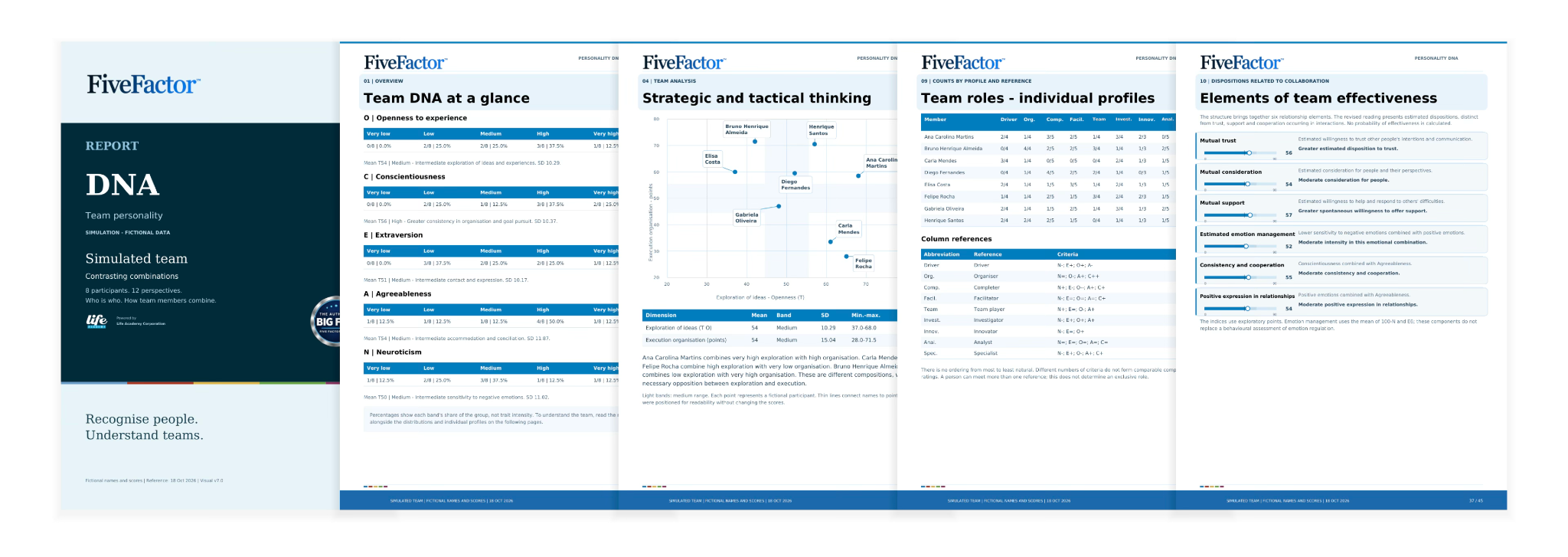
Team overview, strategic and tactical thinking, individual roles and collaboration.
The application approach
From personality data to development.
Understanding becomes useful when profile, context and objectives are connected.
Explore furtherProfile
Read tendencies and combinations across the personality dimensions.
Context
Explore history, environment, relationships and present demands.
Objectives
Clarify what the person or organization wants to develop.
Interpretation
Connect the profile with conversation and relevant evidence.
Development
Translate understanding into priorities, practice and review.
Define the application for your context.
Assessment language, report edition, interpretation format and delivery conditions are confirmed for your market.
“DNA” refers to the team’s combination of personality characteristics.
Your next step
Let’s turn understanding into a conversation.
Tell us about your context and what you would like to develop.
Discuss Your Needs